An ex-quant trader is building AI that finishes your thoughts as you type
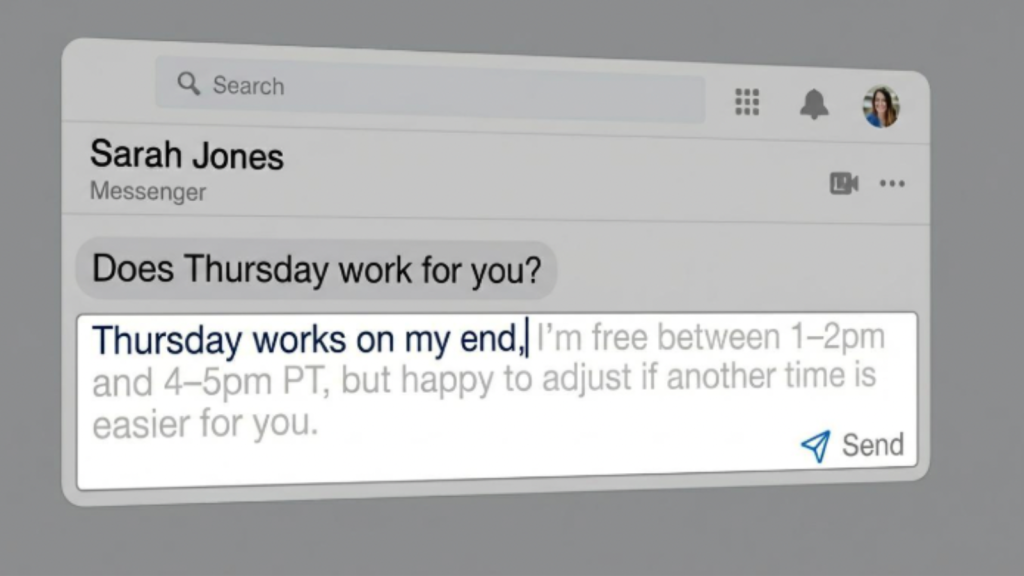
Photo courtesy SmartReply
Opinions expressed by Digital Journal contributors are their own.
For most people, using AI to write means breaking their flow: leave the app, open a chatbot, prompt, copy, paste, repeat. The process fragments writing rather than supporting it.
Leo Jing believes this workflow is fundamentally inefficient. “In the AI era, writing assistance shouldn’t live somewhere else,” he says. “It should appear exactly where people type.”
Jing, a former hedge fund quantitative trader, is building AstraBreeze, Inc. alongside co-founder Lucas Muehleisen to address that gap. Their flagship product, SmartReply, is a macOS application designed to embed predictive AI directly into the typing experience. Rather than relying on chat windows or side panels, SmartReply works across any text field on macOS. Wherever the cursor exists, the AI is present, predicting intent and completing thoughts in real time.
“Writing hasn’t evolved at the interface level in decades,” Jing says. “We still rely on static keyboards and shallow autocomplete. But now AI understands language deeply enough to change how thoughts become text.”
The company has drawn early backing from Character Capital, a venture firm founded by former Google Ventures partners that focuses on technically ambitious founders building foundational AI software products. Character Capital has previously backed companies operating at the intersection of advanced research, developer tooling, and consumer infrastructure. The firm’s support signals early institutional interest in the idea of predictive, system-level AI beyond chatbot interfaces.
Jing describes SmartReply’s mission simply: Typing, reimagined — AI that finishes your thoughts everywhere you write.
From market prediction to human expression
Jing’s path to building SmartReply began in large-scale prediction systems. Before founding the company, his career includes building autonomous trading strategies at elite hedge funds such as Point72’s Cubist and Balyasny, contributing to causal inference systems at Amazon, and participating in research efforts tied to NeurIPS publications and reviews.
Earlier in his academic journey, Jing declined an offer from MIT and intentionally chose UC Berkeley, prioritizing proximity to the Bay Area founder ecosystem rather than traditional academic prestige. This decision laid the foundation for a career focused on entrepreneurship.
The idea behind SmartReply emerged from a simple friction.
As a non-native English speaker, Jing frequently relied on ChatGPT to rephrase professional messages and emails. Each interaction pulled him out of his workflow, creating a routine detour from direct communication.
What began as a personal inconvenience revealed a broader problem. Founders, recruiters, sales teams, support agents, and other knowledge workers all experience similar interruptions when using current AI writing tools.
The insight was not just about generating better text but also removing the break between intent and expression.
Beyond the chatbot interface
Despite the explosion of generative AI tools, most writing products still rely on chatbot workflows that force users out of their active task. Browser assistants remain limited by platform scope, and native autocompletion rarely extends beyond word-level prediction.
SmartReply takes a different approach: instead of operating as a chat interface layered on top of apps, it integrates directly into the macOS desktop experience.
With a global shortcut, the application reads on-screen context and generates inline suggestions at the cursor. There is no need to switch windows or transfer output across tools. Writing stays continuous.

Predictive AI typing
SmartReply’s core concept is what Jing calls predictive AI typing.
“Traditional autocomplete finishes words,” Jing says. “We finish thoughts.”
SmartReply finishes partial sentences, proposes responses, structuring follow-ups or concise replies with minimal prompting. Users can trigger suggestions even without typing anything or after only a few words.
The design reframes AI as an extension of typing rather than an external editor.
Personalization through AI twins
One challenge in AI writing tools is generic phrasing. Without personalization, generated content rarely reflects the distinct voice of individual users.
SmartReply addresses this through AI twins, personalized models that adapt to how each person communicates over time. The system learns vocabulary patterns, phrasing preferences, and tonal habits from a user’s interactions and, optionally, from connected documents or data sources.
This personalization allows suggestions to align more naturally with a user’s style instead of sounding like standardized model output.
All personalization stays fully under the user’s control, with privacy protected at every step.
Building the input layer
Jing views SmartReply as part of a broader attempt to rethink how humans interact with computers.
Instead of requiring users to summon intelligence through prompts and chat windows, SmartReply embeds AI persistently at the point of input itself. Contextual assistance follows users across applications without repeated setup or workflow disruption.
This persistent, system-level approach reflects a belief that intelligence should exist alongside ordinary actions rather than behind separate interfaces.
“Every major shift in computing changed how humans input information,” Jing says. “From command lines to mice. From mice to touch screens. Now prediction becomes the next layer.”
Founder-led execution
SmartReply’s development reflects hands-on founder execution.
Before AstraBreeze, Jing built FoodRelay, a logistics startup launched during the pandemic that reached significant traction without launching a mobile app, relying instead on rapid iteration and viral distribution. The experience shaped his approach to product validation outside conventional playbooks.
He now builds alongside Lucas Muehleisen, a repeat founder with more than 14 years of engineering experience across consumer products, AI systems, and open-source infrastructure. Muehleisen previously grew ventures including PetShelf and Etesian to profitable, revenue-generating businesses.
Together, the founders combine predictive systems expertise with consumer product execution, supported by early institutional backing that reflects growing interest in AI products built at the systems layer rather than solely within chatbot environments.
Rethinking writing
For decades, keyboards and manual composition limited the speed at which ideas became communication. Predictive AI typing compresses that gap, enabling intent to surface more fluidly as written language.
If that shift succeeds, writing begins to resemble real-time expression rather than step-by-step transcription.
As Jing sees it, that transformation begins at the most fundamental surface of computing.
The cursor.
An ex-quant trader is building AI that finishes your thoughts as you type
#exquant #trader #building #finishes #thoughts #type