Iceberg A-23A Turns Deep Blue in Final Days, Marking End of a Forty-Year Giant


A massive chunk of ice from Antarctica’s Filchner Ice Shelf broke off 40 years ago, in 1986. This gigantic iceberg was given the name A-23A, and as it entered the globe, it made history in a big way, as the ice covered 4,000 square kilometers, nearly twice the size of Rhode Island.
Scientists have been attentively following this ice age survivor since it broke loose; most icebergs do not survive more than a few years in warmer waters, but A-23A refuses to give up. It was unsuccessful in calving, so it ground out in the shallow Weddell Sea and remained cemented to the seafloor for nearly 30 years, creating a frozen monument while the world changed around it.
By 2020, things had begun to change, with currents and winds loosening its grip on the seafloor and A-23A eventually drifting. It was about to enter a swirling ocean vortex known as a Taylor column, and the slow dance had begun, which would last several months. Narrow escapes came and went, with one close miss with South Georgia Island, followed by some shallow water to stop it in its tracks again.
Some time during late 2025, A-23A had made it into the open South Atlantic and was being driven north by the currents towards warmer waters. Breakups began in July, August, and September, and significant portions were soon removed from the berg. By mid-January 2026, its surface area had fallen to a gigantic 1182 square kilometers, a far cry from its initial grandeur, but still impressive, greater than New York City.
Satellite photos, of course, captured the latest part in A-23A’s life story; on December 26, NASA’s Terra satellite obtained some magnificent photos of the berg with enormous pools of meltwater all over its surface, turning the ice a gorgeous shade of blue and visible from orbit.
The next day, an astronaut on the International Space Station photographed it up close, revealing even more blue patches on its surface. This melt water occurs in the surface snow and ice when it is exposed to sunlight in the summer; it collects in cracks and depressions and is known as “blue mush.” You can also see the berg’s original hills and valleys, which were formed when the Antarctic bedrock was formed and channeled the flow into linear patterns. The berg’s margins were a thin white rim all around, acting as a moat to keep the water in place as the ice melted from beneath.
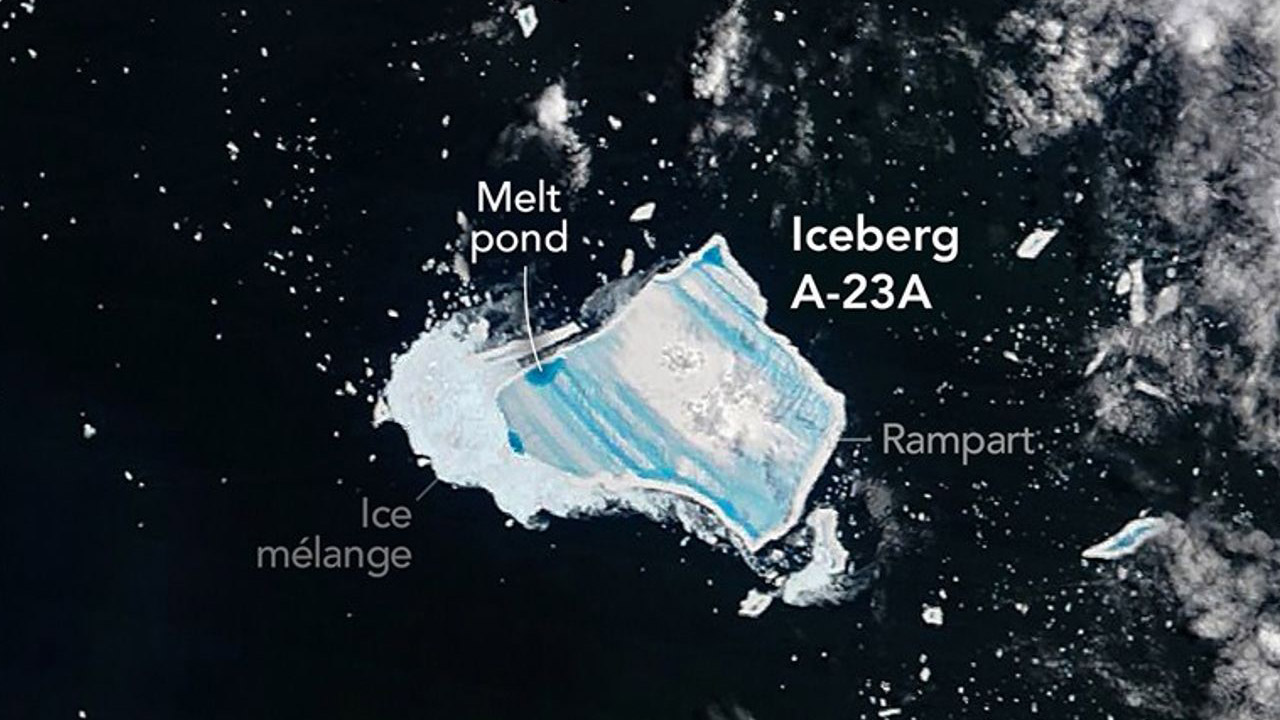
Pressure rose up from the weight of the water, and fissures began to widen. In several areas, the force simply burst through, spewing freshwater plumes into the surrounding sea. One of the photographs showed a definite blowout, indicating that the berg’s structural integrity was failing. Glaciologists see these signs as a final wake-up call, essentially.Ted Scambos, a senior researcher at the University of Colorado Boulder, describes the blue mush as proof that the berg is breaking apart right in front of us, whereas Chris Shuman, a retired scientist from the University of Maryland, witnessed the berg’s long and eventful journey but believes it is nearing the end.
A-23A is simply drifting around in icy waters around 3 degrees, being driven along by currents into a region known as an iceberg graveyard. The Southern Hemisphere summer offers brighter skies and warmer temperatures, so melt is increasing from both above and below. Researchers believe it will be days or weeks before the berg entirely breaks apart, and likely before the end of the season. Four decades of A-23A data have proven to be a valuable resource for patient observers. Satellites have been able to watch its grounding, near-collisions, and slow, steady fall over time, providing insight into how giant icebergs behave in a warming ocean.
[Source]
Iceberg A-23A Turns Deep Blue in Final Days, Marking End of a Forty-Year Giant
#Iceberg #A23A #Turns #Deep #Blue #Final #Days #Marking #FortyYear #Giant