Hubble Spots the Biggest Disk of Chaos Yet Around a Young Star
A team of astronomers has observed the largest protoplanetary disk ever seen circling a young star some 1,000 light years away. This churning expanse of gas and dust spans roughly 400 billion miles, 40 times the size of our solar system and extending to the Kuiper Belt. They’ve cataloged this disk as IRAS 23077+6707, also known as Dracula’s Chivito, and it’s easy to see why given its completely opaque center, which Hubble’s high resolution photo has peeled away to reveal a really odd image.
Hubble’s Wide Field Camera 3 captured an image of the disk almost edge-on, resulting in a dramatic silhouette. A vast dark lane runs down the middle, with very light streaks of material rising all around it, some of which are reaching for the sky like crazy, and they’re far higher up than we’ve ever seen in a disk before. What’s even more unusual is that these wisps are all crooked, with one side being much more prominent than the other. That appears like there’s still a lot of new material coming in, as well as some very powerful gravitational forces at work, changing the entire structure right now.
Sale

LEGO Icons NASA Space Shuttle Discovery Building Sets for Adults – Model Kits for Bookshelf or Office…
- LEGO NASA Space Set – This adult LEGO set features the Space Shuttle Discovery and the Hubble Space Telescope from NASA’s 1990 STS-31 mission,…
- Solar System Exploration – Unlock the mysteries of our solar system with this engaging 2,354-piece project, packed with authentic details and…
- Shuttle Features Galore – The space shuttle model has an opening payload bay, retractable landing gear, opening cockpit, moving elevons, space arm,…
The disk itself has enough mass to form a large planetary system, equivalent to a million Jupiters, and planets develop from these disks as pieces of gas as well as dust clump together. But, given how big and tumultuous this thing is, it appears that the norms of our own solar system do not apply here. Massive protoplanetary disks like this one appear to function differently, as if they were a whole new world to explore and learn about. Hubble’s observations are only getting started, and they are already revealing how much we still don’t know about the early days of words like ours.
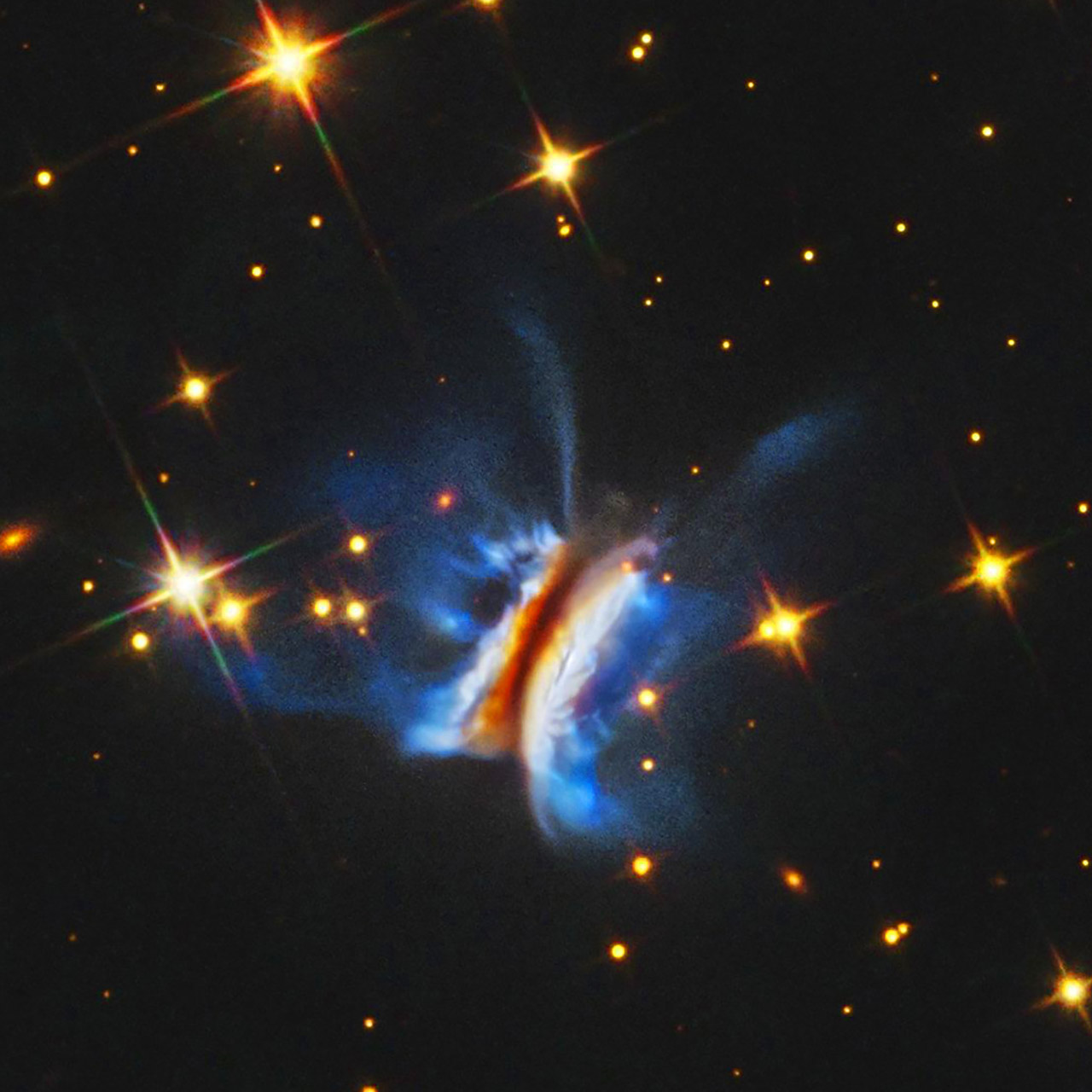
Lead author Kristina Monsch from the Center for Astrophysics | Harvard & Smithsonian described the rarity of this view: “The level of detail we’re seeing is rare in protoplanetary disk imaging, and these new Hubble images show that planet nurseries can be much more active and chaotic than we expected.” She added that the edge-on perspective lets astronomers trace substructures in visible light with exceptional clarity, making this system a prime laboratory for planet formation studies.
Co-investigator Joshua Bennett Lovell shared his surprise at the asymmetry: “We were stunned to see how asymmetric this disk is. Hubble has given us a front row seat to the chaotic processes that are shaping disks as they build new planets—processes that we don’t yet fully understand but can now study in a whole new way.” Monsch noted that while the disk could host many planets, the current images raise more questions than answers. They provide a solid starting point for exploring how planets form across different conditions and over time.
Hubble Spots the Biggest Disk of Chaos Yet Around a Young Star
#Hubble #Spots #Biggest #Disk #Chaos #Young #Star