Asteroid mining: The next big thing for space missions?
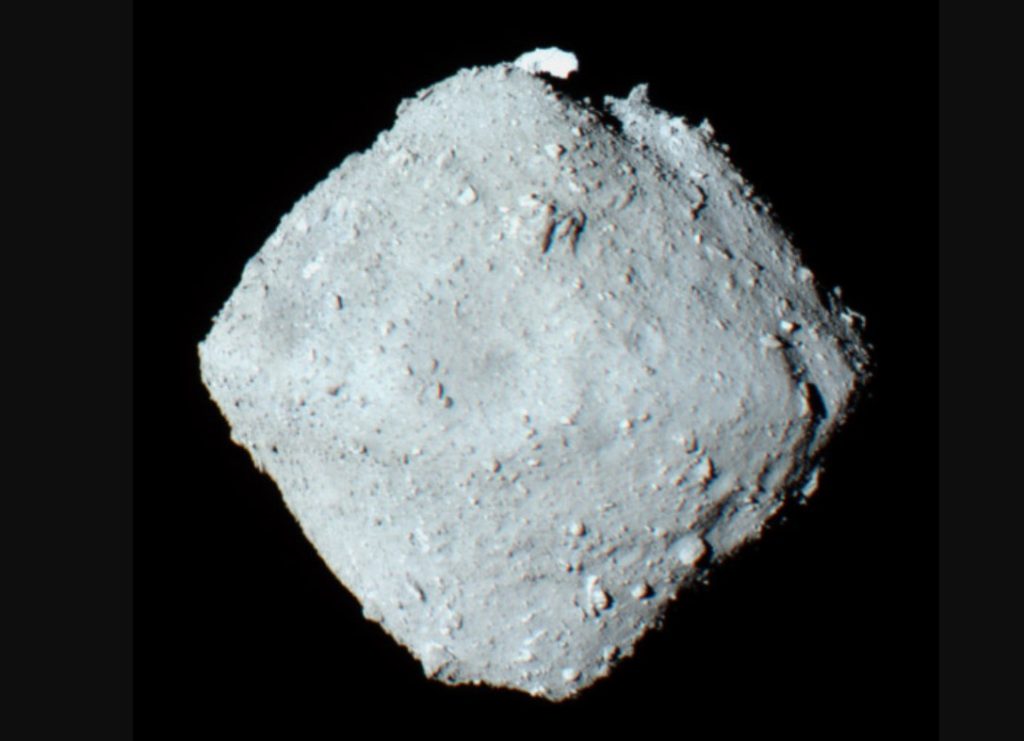
This is a colored view of the C-type asteroid 162173 Ryugu, seen by the ONC-T camera on board of Hayabusa2.
Source – ISAS/JAXA, CC SA 4.0.
Scientists are assessing the makeup of carbon-rich asteroids to see whether they could one day fuel space exploration—or even be mined for valuable resources. For long duration missions to the Moon and Mars, using materials found in space could significantly reduce the need for supplies launched from Earth. However, improved identification and classification is required to track asteroids altered by water and rich in water bearing minerals.
What are asteroids really made of? New analysis brings space mining closer to reality.
By analysing rare meteorites that naturally fall to Earth, researchers have uncovered clues about the chemistry, history, and potential usefulness of these ancient space rocks. While large-scale asteroid mining is still far off, the study highlights specific asteroid types that may be promising targets, especially for water extraction.
The research team is led by the Institute of Space Sciences (ICE-CSIC) and here scientists examined samples linked to C-type asteroids, carbon rich objects that are believed to be the original sources of carbonaceous chondrites.
C-type asteroids are the most common type, making up about 75% of all known asteroids in the solar system. Their composition includes carbon compounds, silicate minerals, water, and organic materials.
Carbonaceous chondrites arrive on Earth naturally, but they account for only about 5% of all meteorite falls. Many are extremely fragile and break apart before they can be recovered, which makes them especially rare. When they are found, it is often in desert environments such as the Sahara or Antarctica, where preservation conditions are favourable.

Source – NASA/JPL-Caltech/UCLA. Public Domain
Digging into the research data
The ICE-CSIC team selected and carefully characterized asteroid related samples before sending them for detailed chemical analysis. The measurements were performed using mass spectrometry at the University of Castilla-La Mancha. This work allowed the researchers to determine the precise chemical make-up of the six most common types of carbonaceous chondrites and assess whether extracting materials from their parent asteroids could one day be practical.
The Asteroids, Comets, and Meteorites research group at ICE-CSIC has spent more than a decade studying the physical and chemical properties of asteroid and comet surfaces.
While many small asteroids are covered in loose surface material known as regolith, collecting small samples is very different from extracting resources at scale.
Regolith is a blanket of unconsolidated, loose, heterogeneous superficial deposits covering solid rock.
The results arguably strengthen the case that these asteroids could serve as important material reservoirs. The findings also help scientists identify where these meteorites came from and support planning for future space missions and resource extraction technologies.
While asteroids contain other minerals of interest, most asteroids only have relatively small abundances of precious elements, and therefore the objective of the research has also been to understand to what extent their extraction would be viable for a government or commercial operation.
Need for classification
The main asteroid belt contains an enormous range of objects, and understanding what resources they hold requires careful classification. Asteroid composition varies widely due to their long and complex histories, influenced by their evolutionary history, particularly collisions and close approaches to the Sun. Certain asteroids, from which hydrated carbonaceous chondrites originate, will have fewer metals in their native state, but they contain water, meaning that different asteroids will provide different benefits for future space explorers and space miners.
Overall, given current technology and costs, the researchers are of the view that mining undifferentiated asteroids — the primordial remnants of the solar system’s formation, considered the progenitor bodies of chondritic meteorites — remains impractical for now. However, with an improved classification system and identification, a future state will be to pinpoint very specific asteroids of economic or practical significance.
Mining: Future political debate
Asteroids are not subject to national appropriation according to the Outer Space Treaty. Whether they are owned by no one or by all of humanity under common heritage is still a matter of legal debate.
The findings appear in the journal Monthly Notices of the Royal Astronomical Society, titled “Assessing the metal and rare earth element mining potential of undifferentiated asteroids through the study of carbonaceous chondrites.”
Asteroid mining: The next big thing for space missions?
#Asteroid #mining #big #space #missions